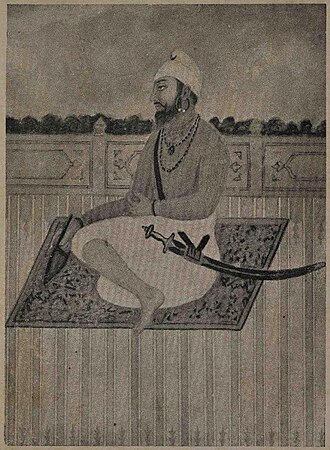
Kavi Santokh Singh
Kavi Santokh Singh (1787-1843) was a major Sikh poet-historian, author of Sri Gur Pratap Suraj Granth and Nanak Prakash.
Portrait via Wikimedia Commons.
Courses
Guru Nanak Dev Ji: Life and Teachings
This course studies the life and message of Guru Nanak Dev Ji (1469-1539), the founder of the Sikh faith, in an academic but accessible way. It traces his birth at Nankana Sahib, the spiritual awakening at Sultanpur Lodhi, the four Udasis or great journeys, his central teachings on the One Creator, honest work,…
The Lives of the Ten Gurus
This course surveys the lives, teachings, and contributions of the ten human Gurus, from Guru Nanak Dev Ji to Guru Gobind Singh Ji, and the conferral of eternal Guruship upon ਸ੍ਰੀ ਗੁਰੂ ਗ੍ਰੰਥ ਸਾਹਿਬ ਜੀ. It pays special attention to how the devotional chronicles of Kavi (Bhai) Santokh Singh, above all his Sri Gur…
Guru Amar Das Ji: Equality and Reform
Guru Amar Das Ji (1479-1574), the Third Guru of the Sikhs, led the community from 1552 to 1574. This course studies his life and his lasting reforms. He built the town of Goindwal and its famous Baoli Sahib, and he made the rule that every visitor, of any rank, must first sit together and eat in the langar before…
Guru Angad Dev Ji: The Second Master
This course studies the life and contributions of Guru Angad Dev Ji (1504-1552), the Second Master of the Sikhs. Born Bhai Lehna, he met Guru Nanak Dev Ji at Kartarpur and was chosen as successor in 1539, over Guru Nanak's own sons, because of his humility and devoted service. As Guru he settled at Khadur Sahib,…
Guru Har Krishan Ji: The Child Guru's Seva
Guru Har Krishan Ji (1656-1664) was the Eighth Guru of the Sikhs and became Guru as a young child, around the age of five, in 1661. This course studies his short but luminous life: his early succession after Guru Har Rai Ji, his journey to Delhi at the call of the Mughal court, and his remembered service to the…
Guru Har Rai Ji: Compassion and Care
Guru Har Rai Ji (1630-1661) was the seventh Sikh Guru, serving the community from 1644 to 1661. A grandson of Guru Hargobind Sahib Ji, he is remembered above all for his deep compassion and gentleness toward every living creature. This course studies his life and leadership: how he kept the Sikh community strong…
Guru Angad Dev Ji: The Second Master's Life and Ministry
This course examines the life, discipleship, and Guruship of Guru Angad Dev Ji (1504–1552), the second Guru of the Sikhs. Students will trace his origins as Lehna, a devoted Vaishnav, through his transformation into the chosen successor of Guru Nanak Dev Ji. Key themes include tests of devotion, the meaning of the name Angad, and the institutional contributions that shaped the young Panth.
Langar, Sangat, and the Expansion of Community Under Guru Angad Dev Ji
This course examines the development of the Langar and Sangat institutions under Guru Angad Dev Ji's ministry at Khadur Sahib, with particular attention to the role of Mata Khivi. Students will explore how communal eating and congregational worship functioned as engines of social equality and community formation in sixteenth-century Punjab, and trace the theological foundations of these institutions in Sikh teaching.
Physical Fitness and the Akhara: Guru Angad Dev Ji's Embodied Legacy
This course examines Guru Angad Dev Ji's establishment of the akhara — a wrestling and physical fitness gymnasium — at Khadur Sahib, and its significance for Sikh understandings of the body, health, and spiritual practice. Students will explore the theological basis for physical cultivation in Sikhism, the historical context of the akhara tradition in Punjab, and how Guru Angad Dev Ji's embodied legacy connects to the later development of the Khalsa ideal of the saint-soldier.
Guru Amar Das Ji: Life, Discipleship, and Calling
This course examines the remarkable life of Guru Amar Das Ji (1479–1574), who became a devoted Sikh disciple at the age of sixty-one and received the Guruship at seventy-three. Students will trace his biography from his early Vaishnav practice through his transformation under Guru Angad Dev Ji, his ministry at Goindval, and his legacy as a Guru who demonstrated that spiritual transformation is possible at any stage of life.
Guru Har Rai Ji: The Quiet Ministry of the Seventh Guru
This introductory course surveys the life and ministry of Guru Har Rai Ji (1630-1661), the Seventh Nanak, whose seventeen-year Guruship is characterised by compassion, healing, ecological sensitivity, and spiritual depth maintained without resort to warfare. Students explore how a Guru who fought no battles nonetheless advanced the Panth's spiritual and institutional development in significant ways.
Guru Har Krishan Ji: The Child Guru
This course examines the life of Guru Har Krishan Ji, the eighth Sikh Guru, who acceded to the Gurgaddi at the age of five and passed away at age seven. Drawing on Kavi Santokh Singh's Sri Gur Pratap Suraj Granth and other historical sources, students explore his installation, his spiritual authority, and the enduring significance of his short but powerful ministry.
Guru Ram Das Ji: Life, Service, and the Path to Guruship
This course traces the life of the Fourth Sikh Guru, Sri Guru Ram Das Ji (1534–1581), from his humble origins as Bhai Jetha in Lahore through his years of selfless service to Guru Amar Das Ji, and his eventual installation as Guru. Students will explore how Guru Ram Das Ji embodied the qualities of humility, dedication, and love that define the ideal Sikh. The course draws on Kavi Santokh Singh's Suraj Parkash Granth and other classical sources to examine the historical, social, and spiritual dimensions of his life.
Guru Ram Das Ji and the Elevation of Seva
Seva — selfless service — is one of the most central expressions of the three foundational pillars of Sikh spiritual practice: Naam Japo (naam simran — meditation on the divine name), Kirat Karo (honest work), and Vand Chhako (sharing one's earnings with others). Daswandh, the practice of contributing one-tenth of one's earnings, is the specific institutional form that Vand Chhako takes.
Guru Gobind Singh Ji and the Birth of the Khalsa
This course studies the life of Guru Gobind Singh Ji, the tenth Guru, and the founding of the Khalsa. It follows his birth in 1666, the martyrdom of his father, the founding of the Khalsa on Vaisakhi 1699, the first Amrit Sanchar and the Panj Pyare, the sacrifice of the Sahibzade, and the 1708 conferral of eternal…
Guru Ram Das Ji: Founder of Amritsar
Guru Ram Das Ji (1534-1581) was the fourth of the ten Sikh Gurus and led the community from 1574 to 1581. Born in Lahore as Bhai Jetha, he is remembered for founding the settlement of Ramdaspur, which later grew into the city of Amritsar, and for beginning the excavation of its great sarovar (sacred pool). He…
Gurmukhi Script: Guru Angad Dev Ji's Gift to the Panth
This course examines the Gurmukhi script — its origins, structure, standardization under Guru Angad Dev Ji, and its profound role in Sikh identity and literacy. Students will learn the historical context of script development in Punjab, the theological significance of writing as a form of service to Gurbani, and how Gurmukhi became the medium through which the Sikh scriptural tradition was preserved and transmitted.
The Manji System: Guru Amar Das Ji and Scaling the Panth's Institutions
This course examines the Manji system established by Guru Amar Das Ji — a network of 146 district-level community leaders that organized the geographically expanding Sikh Panth in the sixteenth century. Students will trace the origins, structure, and function of the system, its relationship to other Sikh institutional innovations, and its significance as an early model of distributed religious organization.
The Baoli at Goindval and Sacred Geography
This course examines the baoli (step-well) constructed at Goindval under Guru Amar Das Ji and its significance as a sacred site, a center of pilgrimage, and an expression of Sikh theology about sacred space and geography. Students will explore the construction of the baoli, the spiritual practice associated with its eighty-four steps, and how Goindval became an early Sikh pilgrimage center that offered an alternative to the dominant Hindu and Muslim sacred geography of northern India.
Guru Gobind Singh Ji: Early Life, Patna Sahib, and the Crucible Years at Anandpur
This course examines the early life of Guru Gobind Singh Ji from his birth in Patna in 1666 CE through his formative years in the Shivalik hills at Anandpur Sahib. Drawing on Kuir Singh's Gurbilas Patshahi 10 and other primary sources, students trace the Guru's childhood, education, assumption of Guruship after his father's martyrdom, and the socio-political environment that shaped his mission. The course grounds each episode in documented historical evidence while noting where scholarly debate persists.
Nanded, the Final Hukam, and the Eternal Guruship of the Granth and Panth
This course examines the final years of Guru Gobind Singh Ji's life at Nanded in the Deccan, his encounter with Banda Singh Bahadur, the stabbing incident and its aftermath, and the momentous final Hukam (divine command) that conferred eternal Guruship on the Sri Guru Granth Sahib Ji and the Khalsa Panth. The course explores the theological significance of this transition and its enduring consequences for Sikh identity, ecclesiology, and daily practice.
The First Udasi: Guru Nanak's Journeys East — Sultanpur to Assam
This course traces Guru Nanak's first great journey (udasi) eastward from Sultanpur Lodhi, following the accounts preserved in the Janamsakhis and Kavi Santokh Singh's Sri Nanak Prakash. Students examine key encounters at Hardwar, Benaras, Gaya, Puri, and the distant eastern reaches including Dhubri and Assam. The course grounds devotional narrative in historical geography and critically evaluates the sources that preserve these accounts.
The Second Udasi: Guru Nanak's Journeys South — Deccan, Tamil Nadu, and Sri Lanka
This course traces Guru Nanak's second great journey southward through the Deccan plateau, Tamil Nadu, Rameshwaram, and across to Sri Lanka (Lanka), following janamsakhi accounts and Kavi Santokh Singh's Sri Nanak Prakash. Students examine Guru Nanak's encounters with Nath yogis, Shaivite and Vaishnava communities, and diverse regional spiritual traditions. The course critically evaluates how these southern journeys expanded the geographic and theological scope of early Sikhism.
The Third Udasi: Guru Nanak's Journeys North — Kashmir, Sumer Parbat, and Tibet
This course traces Guru Nanak's third great journey northward into Kashmir, the Himalayan peaks, and the Tibetan plateau, following janamsakhi accounts and Kavi Santokh Singh's Sri Nanak Prakash. Students examine the Sidh Gosht dialogue tradition, Guru Nanak's encounters with Brahmin scholars in Kashmir, and the theological significance of the mountaintop encounters with Nath Siddhs. The course evaluates the scholarly debate over whether the Sidh Gosht represents a historical encounter or a literary-theological dialogue.
The Fourth Udasi: Guru Nanak's Journeys West — Sindh, Mecca, Medina, and Baghdad
This course traces Guru Nanak's fourth and final great journey westward through Sindh, Pak Pattan, Mecca, Medina, Baghdad, and Kabul, following janamsakhi accounts and Kavi Santokh Singh's Sri Nanak Prakash. Students examine the most famous episodes of the Udasi tradition — the Mecca Kaaba sakhi, the meeting with Bahlol Dana in Baghdad — and analyze what these encounters reveal about Guru Nanak's theology of divine omnipresence and his engagement with Islam at its most sacred sites.
Guru Hargobind Sahib Ji: Life and the Transformation of the Panth
This course traces the life of the Sixth Nanak, Guru Hargobind Sahib Ji (1595–1644), from his birth at Wadali through his long Guruship of thirty-eight years. Students examine how the Guru transformed the Panth from a devotional community into a sovereign people, responding to his father Guru Arjan Dev Ji's martyrdom with institutional, military, and spiritual innovations that continue to define Sikhi.
Miri-Piri: The Two Swords and a New Sikh Identity
This course provides a deep theological and historical examination of the Miri-Piri doctrine introduced by Guru Hargobind Sahib Ji in 1606. Students explore the conceptual foundations of this doctrine in earlier Gurbani, its institutional expression in the two swords and the Akal Takht, and its enduring significance for Sikh political theology and identity.
The Akal Takht: Origins, Purpose, and Enduring Significance
This course provides a comprehensive historical and theological examination of the Akal Takht, established by Guru Hargobind Sahib Ji in 1606 CE. Students trace the structure's origins, its functions in the Guru period, its destruction and rebuilding, and its continuing role as the supreme temporal authority of the Sikh Panth.
Prisoner and Liberator: The Gwalior Fort and the Bandi Chhor
This course provides a detailed historical and theological study of Guru Hargobind Sahib Ji's imprisonment in Gwalior Fort by Emperor Jahangir and the celebrated Bandi Chhor episode in which the Guru secured the release of fifty-two imprisoned kings. Students examine the historical sources, the theological significance of collective liberation, and how Bandi Chhor Divas became one of the most important commemorations in the Sikh calendar.
Healing, Herbs, and Compassion: Guru Har Rai Ji's Medical Legacy
This course examines Guru Har Rai Ji's extensive practice of herbal medicine and healing at Kiratpur, situating it within Sikh theology, the history of South Asian medical knowledge, and the continuing Sikh tradition of healing seva. Students learn about the medicinal plants maintained in the Guru's garden, the theological basis for healing ministry, and the practical expression of sarbat da bhala through medical service.
Guru Har Rai Ji and the Preservation of Gurbani
This course examines Guru Har Rai Ji's role as a guardian of the Gurbani's integrity, focusing on the theological principles that governed his approach to scripture, the Ram Rai episode as a test case of these principles, and the broader Sikh tradition of scriptural preservation. Students explore the Sikh understanding of the Shabad Guru and the responsibilities it places on each generation to protect and transmit the divine Word unchanged.
Guru Har Rai Ji's Wildlife Sanctuary and Ecological Consciousness
This course explores Guru Har Rai Ji's maintenance of a wildlife sanctuary and botanical garden at Kiratpur as an expression of Sikh ecological theology. Students examine how the Guru's practice of caring for rare animals and plants reflects the Gurbani's vision of creation as divine, the principle of sarbat da bhala extended to all living beings, and the enduring relevance of this ecological consciousness for contemporary Sikh environmental engagement.
Guru Har Krishan Ji: Serving Delhi During the Smallpox Epidemic
This course provides a focused examination of Guru Har Krishan Ji's humanitarian service during the smallpox and cholera epidemic that struck Delhi in the early 1660s. Drawing on hagiographical sources, Sikh ethical principles, and historical context, students analyze the Guru's selfless actions as an expression of Sikh seva, the epidemic's human toll, and the enduring memory preserved at Gurdwara Bangla Sahib.
The Brahmin's Test: Waheguru's Grace Through the Child Guru
This course provides a detailed examination of the famous episode in which the Brahmin Lal Chand brought the illiterate water-carrier Chhaju Ram before Guru Har Krishan Ji in Delhi as a test of the child Guru's spiritual authority. Through close analysis of this narrative, students explore its anti-caste theology, its challenge to Brahminic religious monopoly, and its enduring significance in Sikh tradition.
The Succession Dispute: Ram Rai, Aurangzeb, and the Protection of Gurbani
This course examines the succession dispute that defined Guru Har Krishan Ji's installation as Guru, focusing on Ram Rai's alteration of Gurbani at Aurangzeb's court and Guru Har Rai Ji's principled response. Students analyze the theological stakes of Gurbani's integrity, the political dynamics of Mughal-Sikh relations in the 1650s-1660s, and the lasting consequences of the Ram Rai schism for the Sikh community.
Baba Bakale: The Guru's Last Words and the Search for a Successor
This course examines the episode known as 'Baba Bakale' — Guru Har Krishan Ji's dying words directing the Sikh community to the village of Bakala where the next Guru would be found — and the subsequent search and identification of Guru Tegh Bahadur Ji. Through the story of Makhan Shah Lubana's recognition of the true Guru, students explore Sikh theology of succession, community discernment, and the transition from the eighth to the ninth Guru.
The Legacy of the Eighth Guru: Compassion, Service, and Gurdwara Bangla Sahib
This course provides a comprehensive assessment of the legacy of Guru Har Krishan Ji — the Child Guru — examining how his brief ministry has shaped Sikh devotional life, communal values, and institutional practice across three and a half centuries. Students explore the Guru's place in Sikh liturgy, the development of Gurdwara Bangla Sahib, the theological significance of the child Guru paradigm, and the continuing relevance of his example for contemporary Sikh communities.
Guru Tegh Bahadur Ji: Life, Early Years, and the Path to Guruship
This course traces the life of Guru Tegh Bahadur Ji from his birth in 1621 through his early years at Kiratpur, his long contemplative period at Bakala, and his recognition as the ninth Sikh Guru in 1665. Drawing on the Sri Gur Pratap Suraj Granth and other historical sources, students examine the formative experiences that shaped the ninth Guru's spiritual character and prepared him for the most consequential ministry of the Guru era.
The Travels of Guru Tegh Bahadur Ji: Panjab, Bihar, Bengal, and Assam
This course examines the extensive travels of Guru Tegh Bahadur Ji across the Indian subcontinent — from Punjab through Bihar, Bengal, and Assam — during the active years of his Guruship (1665-1675). Drawing on historical sources and hagiographical traditions, students trace the Guru's itinerary, the sangats (communities) he established or strengthened, the Gurbani he composed during these journeys, and the lasting institutional legacy of his travels for Sikh communities in eastern India.
Founding Amritsar: The Sacred Tank and the City of Immortality
This course examines the founding of Ramdaspur — the city that became Amritsar — by Guru Ram Das Ji in the late sixteenth century. Beginning with the excavation of the Amrit Sarovar (Pool of Nectar) under Guru Amar Das Ji's direction, and culminating in the establishment of a thriving urban center during the time of Guru Arjan Dev Ji, this course traces the historical, theological, and architectural dimensions of one of the most significant sacred sites in the Sikh world. Students will engage with questions about how sacred space is created, maintained, and understood within Sikhism.
Hereditary Guruship: Succession, Controversy, and Resolution
The installation of Guru Ram Das Ji as the Fourth Sikh Guru marked a significant institutional shift: for the first time, the Guruship passed to a son-in-law rather than to an unrelated disciple. This course examines the circumstances, significance, and long-term consequences of this transition, including the controversies it generated within the Guru's family and the broader Sikh community. Students will engage with competing historical interpretations of hereditary succession and explore how the Sodhi lineage shaped the next six generations of Sikh Guruship.
Guru Arjan Dev Ji: Life, Ministry, and the First Sikh Martyrdom
Guru Arjan Dev Ji (1563–1606) was the Fifth Sikh Guru and one of the most consequential figures in the history of the Sikh faith. Born the youngest son of Guru Ram Das Ji, he served as Guru for twenty-five years, completing the Harmandir Sahib, compiling the Adi Granth, and — through his martyrdom in 1606 — transforming the entire character of the Sikh movement. This course traces his life and ministry with particular attention to the historical sources available for the period, and examines the multiple dimensions of his lasting legacy.
Harmandir Sahib: Architecture, Theology, and the Four Open Doors
The Harmandir Sahib — the 'Temple of God,' now known worldwide as the Golden Temple — stands at the center of the Amrit Sarovar in Amritsar as the holiest gurdwara in the Sikh world. Completed by Guru Arjan Dev Ji in 1604, its architecture embodies a sophisticated theological vision: the building is below ground level (symbolizing humility), connected by a causeway (the path of devotion), and has four doors open to all four directions (universal welcome). This course examines the architecture, theological symbolism, and historical context of the Harmandir Sahib, as well as its continuing significance for the global Sikh community.
Guru Arjan Dev Ji: The Scripture and the First Martyrdom
Guru Arjan Dev Ji (1563-1606), the fifth Sikh Guru, guided the community from 1581 to 1606. His era shaped Sikhi in lasting ways. He completed the Harmandir Sahib (the Golden Temple) at Amritsar and gave it doors on all four sides as a sign of openness to all people. He compiled the Adi Granth in 1604, gathering…
Guru Hargobind Sahib Ji: Miri-Piri and the Akal Takht
Guru Hargobind Sahib Ji (1595-1644), the Sixth Nanak, became Guru in 1606 following the martyrdom of his father, Guru Arjan Dev Ji. This course studies how he gave the Sikh community a balanced direction by joining spiritual life with worldly responsibility. He wore two swords, one for Miri (temporal authority) and…
Guru Tegh Bahadur Ji: Shield of Conscience
This course studies the life, travels, teaching, and martyrdom of Guru Tegh Bahadur Ji (1621-1675), the Ninth Guru of the Sikhs. He became Guru in 1665, journeyed across northern and eastern India, and founded the town that grew into Anandpur. In 1675 he was executed in Delhi under the Mughal emperor Aurangzeb…
Historical Sources: The Suraj Prakash Account of the Second Guru
This advanced course examines the Sri Gur Pratap Suraj Granth (Suraj Prakash) by Kavi Santokh Singh as a primary source for the history of Guru Angad Dev Ji. Students will learn to read hagiographic literature critically, understand the text's literary conventions, compare its account with other sources, and develop skills for evaluating historical claims in a tradition where history and theology are closely intertwined.
The Battles, the Sahibzade, and the Siege of Anandpur Sahib
This course examines the military history of Guru Gobind Singh Ji's campaigns from the founding of the Khalsa in 1699 through the siege and evacuation of Anandpur Sahib in 1705. Central to the course is the martyrdom of the four Sahibzade (sons of the Guru) and the theological and historical significance of these sacrifices within Khalsa identity. Drawing on Kuir Singh's Gurbilas Patshahi 10, Giani Gian Singh's Twarikh Guru Khalsa, and the Bachittar Natak, students reconstruct the military, political, and spiritual dimensions of this defining period.
The Four Battles: Amritsar, Lahira, Kartarpur, and Phagwara
This course provides a detailed military and political history of the four battles fought by Guru Hargobind Sahib Ji against Mughal imperial forces between 1629 and 1635 CE. Students examine the causes, conduct, and consequences of each engagement, the primary sources that record them, and their enduring significance for Sikh understanding of dharam yudh.
Historical Sources: Gurbilas Patshahi Chevin and the Sixth Guru
This course provides a rigorous scholarly examination of the Gurbilas Patshahi Chevin as a primary source for the life of Guru Hargobind Sahib Ji. Students learn to read the text critically, understand its compositional history, evaluate its historical reliability, and situate it within the broader tradition of Sikh biographical literature.
Dara Shikoh, Aurangzeb, and the Politics of Guru Har Rai Ji's Reign
This advanced course examines the complex political world in which Guru Har Rai Ji conducted his ministry, focusing on the relationships between the Seventh Guru, Mughal Prince Dara Shikoh, and Emperor Aurangzeb. Students analyse how the Guru navigated the Mughal succession crisis, the significance of the healing episode for Sikh-Mughal relations, and the political and theological implications of the Ram Rai affair.
Historical Sources and the Legacy of the Seventh Guru
This advanced course examines the primary and secondary sources available for studying Guru Har Rai Ji's life and ministry, evaluates their relative reliability and limitations, and synthesises the Seventh Guru's multidimensional legacy for the Sikh Panth. Students develop skills in historical-critical source evaluation and construct a nuanced understanding of how historical memory shapes Sikh identity.
Hind di Chadar: The Great Martyrdom for Religious Freedom
This course provides a comprehensive examination of Guru Tegh Bahadur Ji's martyrdom in Delhi in November 1675 — the defining event of his Guruship and one of the most consequential acts of principled sacrifice in world religious history. Students analyze the political circumstances of Aurangzeb's forced conversion campaign, the Kashmiri Pandits' appeal to the Guru, his theological reasoning for defending religious freedom, the martyrdom itself, and the enduring legacy of 'Hind di Chadar.'
Mughal India and the Context of the Ninth Guru's Ministry
This course examines the Mughal political and religious context within which Guru Tegh Bahadur Ji's ministry unfolded, with particular attention to Aurangzeb's reign (1658-1707), the political economy of the empire, and the complex dynamics of Mughal-Sikh relations during the ninth Guru's decade of ministry. Students develop the historical and political literacy needed to understand the martyrdom's context and consequences.
Historical Sources: Gurbilas Patshahi Dasvin and the Scholarly Record
This course offers a rigorous examination of the primary and secondary historical sources for Guru Gobind Singh Ji's life, with sustained focus on the Gurbilas Patshahi 10 of Kuir Singh and its relationship to the Bachittar Natak, Sri Gur Sobha, and Twarikh Guru Khalsa. Students develop skills in source criticism, historiographical method, and the evaluation of conflicting testimonies, learning to distinguish between well-documented events, events known primarily through oral tradition, and events that remain historically uncertain. The course equips students to read Sikh historical literature with scholarly precision.
The Janamsakhis: Devotional Biography and Historical Method
This advanced course examines the Janamsakhi tradition — the devotional biography collections that preserve the life of Guru Nanak — as both historical sources and literary-theological documents. Students learn to distinguish the major Janamsakhi traditions (Puratan, Miharban, Bala, and Gyan Ratanavali), evaluate their relative historical reliability, and apply critical methods to extract historical content from devotional narrative. The course also examines Kavi Santokh Singh's Sri Nanak Prakash as a nineteenth-century synthesis of the tradition.
Historical Sources and the Memory of Hind di Chadar
This advanced course examines the historical sources — Sikh, Mughal, and later — through which memory of Guru Tegh Bahadur Ji's martyrdom has been preserved and transmitted. Students develop critical historical literacy by comparing accounts, assessing their reliability, understanding the genres and purposes of different source types, and engaging with historiographical debates about the martyrdom narrative.
The First Martyrdom: Mughal Politics, Historical Sources, and Legacy
The martyrdom of Guru Arjan Dev Ji in 1606 was a watershed event in Sikh history that transformed the trajectory of the Sikh movement. This advanced course examines the event through multiple historical lenses: the political context of the early Mughal empire under Jahangir, the primary sources (including Jahangir's own Tuzuk-i-Jahangiri), Sikh hagiographical accounts, and modern historical scholarship. Students will develop the skills to evaluate historical sources critically while understanding the theological and communal significance of the martyrdom.
Classical Sikh Poetics
An academic introduction to the classical poetic forms used in Sikh literature, studied through the great narrative works of Kavi (Bhai) Santokh Singh. The course examines metre, figures of speech, mood, and the heroic ballad, and asks how poetic form helps shape religious and historical meaning.
The Garab Ganjani Teeka: A Commentary on Japji Sahib
This course studies the Garab Ganjani Teeka, a prose commentary on Japji Sahib written by Kavi (Bhai) Santokh Singh in the Nirmala tradition of Sikh exegesis. Students learn what a teeka is, who Santokh Singh was, why this particular commentary was written, and the interpretive debate it addressed. The course…
The Sikh Empire: Advanced Political and Military History
This graduate seminar examines the Sikh Empire (1799–1849) through advanced political, military, and administrative lenses, drawing on primary Punjabi sources alongside modern historiography. Students engage critically with court records, Anglo-Sikh diplomatic correspondence, and contemporary scholarship to reassess the nature and legacy of Maharaja Ranjit Singh's state. The course ends with the annexation, its causes, and its long interpretive shadow.
Sikh Resistance: Misl, Akali, and Independence Movements
This graduate seminar examines Sikh resistance from the eighteenth-century <span class='gur'>ਮਿਸਲ</span> period through the twentieth-century independence movements, analyzing the ideological, organizational, and tactical dimensions of <span class='gur'>ਖ਼ਾਲਸਾ</span> resistance to external domination. Students engage critically with primary Punjabi sources alongside colonial and postcolonial scholarship to reconstruct the full arc of Sikh political resistance. The course culminates in analysis of the demand for <span class='gur'>ਆਜ਼ਾਦੀ</span> in the independence and partition era.
Critical Analysis of Primary Sources in Sikh History
This graduate seminar develops rigorous methodological skills for critically analyzing the diverse primary sources used in Sikh historical research, from <span class='gur'>ਗੁਰਬਾਣੀ</span> and early hagiographic literature through colonial administrative records and oral traditions. Students learn to assess the provenance, authorial perspective, genre conventions, and evidential value of each source type, situating them within the broader historiography of Sikh studies. The course equips scholars with the critical toolkit needed for original archival research.
Sikh Narrative Theory and the Janamsakhi Tradition
This graduate seminar applies narrative theory to the study of Sikh hagiographic literature, with particular focus on the <span class='gur'>ਜਨਮਸਾਖੀ</span> tradition and the <span class='gur'>ਗੁਰਬਿਲਾਸ</span> genre. Students engage with contemporary narratological frameworks alongside traditional Sikh literary critical approaches, analyzing how narrative structures, character, point of view, and genre conventions shape the theological meanings of Sikh hagiographic texts. The course develops advanced competence in the literary analysis of Sikh devotional narrative.
Historical Evolution of Sikh Kirtan Traditions
This graduate seminar traces the historical development of Sikh kirtan from Guru Nanak Dev Ji's founding musical ministry through the colonial reform period, the establishment of the SGPC, and the transformations of the global diaspora era. Using the Suraj Prakash and related historical sources alongside modern scholarship, students develop critical frameworks for understanding Sikh kirtan as a living, historically dynamic tradition.
Guru Gobind Singh's Political Vision and Legacy
This course examines the political theology of Guru Gobind Singh, situating his thought within seventeenth-century Mughal imperial crisis and the emergent Sikh sovereign imaginary. Drawing on the Zafarnama, Gurbilas Patshahi 10, and the Suraj Prakash, students analyze how sovereignty, justice, and sacred war were theorized in Guru Gobind Singh's court. The course concludes with long-run assessments of his legacy in Sikh constitutionalism and diaspora political thought.
Historical Evolution of the Sikh Code of Conduct
This graduate seminar traces the rehatnama tradition from Baisakhi 1699 through colonial reform to contemporary diaspora debates, analyzing each period's conduct norms as socially embedded jurisprudence. Students engage primary rehatnama texts alongside the critical scholarship of McLeod, Dhavan, Oberoi, and Mann, developing tools for rigorous historical-theological analysis.
Historical Development of Sikh Theological Thought
This graduate seminar traces the historical development of Sikh theological thought from Guru Nanak's foundational theology through the major doctrinal developments of the ten Gurus, the eighteenth-century contestation, the Suraj Prakash tradition of Kavi Santokh Singh, the Singh Sabha modernization, and contemporary theological engagements. Students analyze how core theological commitments — ਨਾਮ, ਗੁਰੂ, ਸੰਗਤ, ਮੁਕਤੀ — have been progressively elaborated in response to historical challenges while maintaining coherent theological continuity.
Sikh Historiography: Methods, Sources, and Critical Analysis
This graduate seminar examines the production, methods, and critical analysis of Sikh historical writing from the earliest Janam Sakhis through the colonial encounter to the debates of postcolonial Sikh historiography. Students engage with primary historical sources — including the Suraj Prakash Granth, Sikh Rahitnamas, and colonial administrative records — while developing critical tools for evaluating historical claims in the Sikh tradition.
