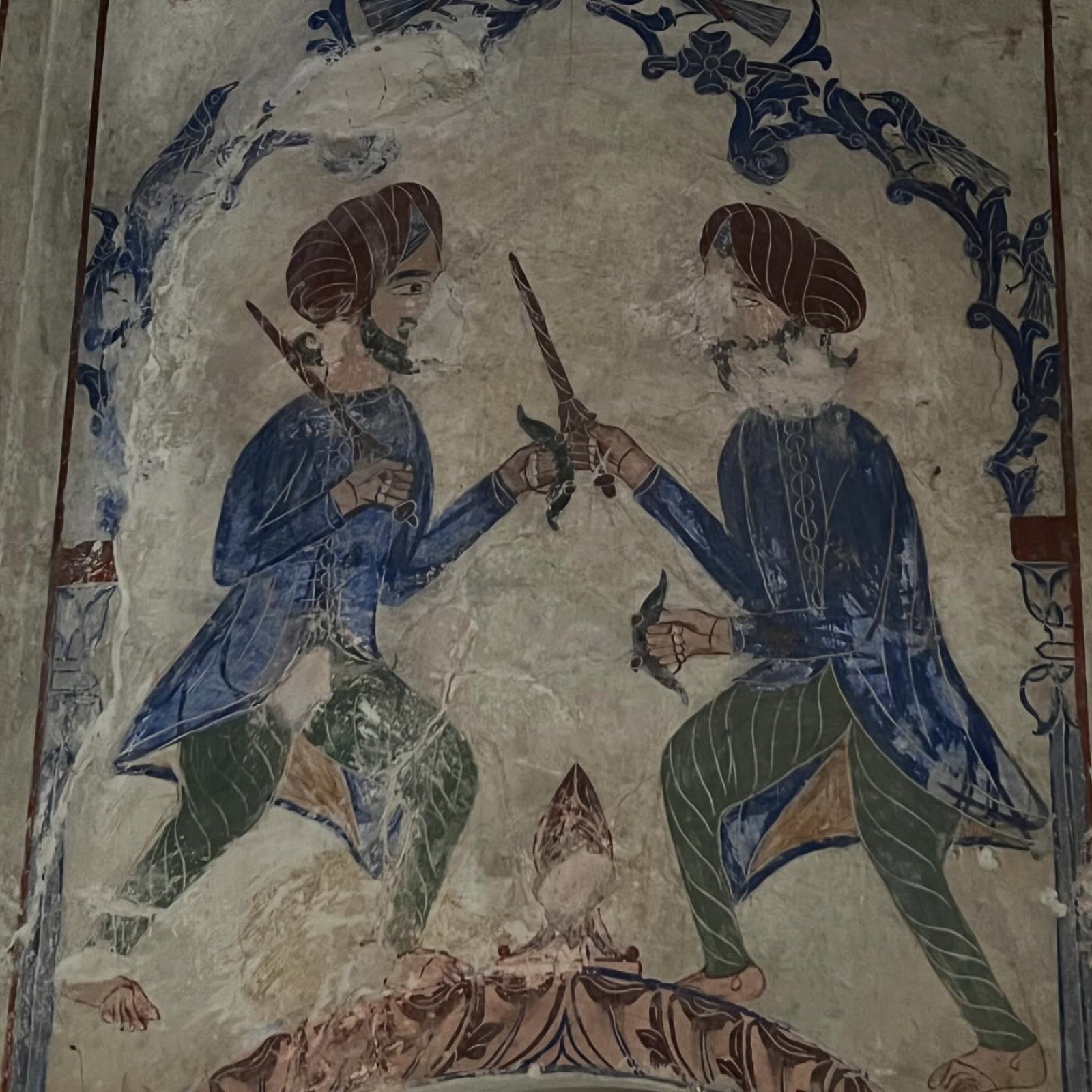
School within Sikhi University
Department of Martial Arts (Shastar Vidya)
Discipline, ancient steel, and the science of the Punjab battlefield.
The Khalsa was raised sant-sipāhī — saint and soldier — and its battlefield art has its own custodians, its own vocabulary, and its own contested history. This department gathers the living tradition's account of itself, drawn from the Baba Darbara Singh Akhara. Where that account is disputed by other Sikh readings, the dispute is named — not settled.
Read the traditionਸੰਤ-ਸਿਪਾਹੀ — the saint and the soldier, in one body
Power from movement, not muscle. Steel that took a lifetime to fold.
The system rests on three principles — locomotion, angling, and power drawn from the sinking of body mass through a technique. Scroll, and the light moves down the blade the way a cut travels.
The akhara's framing is its own and is contested. It uses the term "Sanatan" — timeless — and argues for a Hindu–Sikh cultural continuity that modern reformist Sikh thought, which took shape from the late 19th century, rejects. This department reproduces the tradition's position as the tradition states it; it does not endorse it over other Sikh readings. Doctrinal and historical review by the scholar board precedes any formal course.
What this department is
Three lines of work
The steel
The Indian armoury the system uses — sword, spear, dagger, club, chain-and-ball, chakar, bagh nakha — and how each is carried.
The science
Locomotion, angling, and power drawn from movement rather than muscle — what makes it a battlefield science, not a sport.
The lineage
Nine generations of the Baba Darbara Singh Akhara from 1661, and the revival that brought the art to Britain.
The tradition, in four parts
Drawn from the Baba Darbara Singh Akhara
Each part below is set down as the akhara tells it. Open one to read the detail.
History — from the Shiv Akhara to the Sikh Gurus
The lineage the tradition claims for itself, from ancient ascetic orders to Guru Nanak and the Sikh warrior akharas.
The names the art carries
Shastar Vidiya translates as "the science of weapons": shastar meaning weapon, and specifically edged weapons, and vidiya meaning science. The akhara describes it as a complete traditional Indian battlefield system from the Punjab, joining unarmed technique to the full Indian armoury.
The tradition answers to several older designations, each naming a different aspect of the same art.
- Ayudh Vidiya
- the science of weapons
- Bir / Vir Vidiya
- the science of warriors
- Jujaroo / Loojaroo Vidiya
- the science of those who die fighting for Dharma
- Chatka Gatka
- quick-killing gatka
- Sanatan Shastar Vidiya
- the timeless science of weapons
The pre-Sikh chain
The akhara sets out its history in nine stages: Shiva, the Pashupati, the Kapalika, Taxila, the Natha Sadhus, Guru Nanak, the Ranjit Akhara, the Baba Darbara Singh Akhara, and the lineage of that akhara.
The first five belong to ascetic and warrior currents older than Sikhi itself. The tradition holds that the art was, in its own phrase, a gift from Lord Shiva to the world, and that it passed through those orders before the Sikh Gurus took it up.
Guru Nanak and the Sikh adoption
The akhara records that enlightened ascetic warrior Natha Sadhus identified Guru Nanak (born 1469) as the Yuga Pursh — the man of his age — and bestowed their martial skills as an offering to him. It is explicit that this is not widely known: "The concept of Guru Nanak being an accomplished and sophisticated warrior is not well known outside of the traditional Sikh martial orders."
As physical testimony it points to the Sikh temple at Patna, Bihar, where a sword (tegha), a quoit (chakram) and a pincher (chimta) attributed to Guru Nanak can still be seen. From there the akhara traces the art forward into the Sikh warrior orders — the Ranjit Akhara of the 17th century, and the Baba Darbara Singh Akhara founded in 1661.
The Science — locomotion, angling, power from movement
Three stated principles that make it a battlefield science rather than a sport, and the armoury and combat forms built on them.
The three principles
The tradition sets out its mechanics in three parts, which it treats as one integrated thing rather than three techniques.
- Locomotion
- Body mass is held over the centre of gravity, then do_lana — spilling — shifts that weight directionally, the feet following in measured steps.
- Angling
- A narrow foot stance permits sharper angle cuts than the standard forty-five degrees, one foot often lifted during motion, keeping the opponent constantly misaligned.
- Power generation
- Force derives from movement itself rather than muscular strength or firm grounding — body mass sunk through the technique while kinetic energy is channelled.
The armoury
The system combines unarmed technique with the Indian weapons: swords, spears, daggers, clubs, sticks, chain and ball, chakars (quoits), and bagh nakha — the leopard claw.
The combat forms
The fighting styles, or yudhan, are grouped into three families — the six-limbed Khat Ang Yudhan take animal forms; Sapt Ang Yudhan adds a seventh; and the Dev Ang Yudhan take divine forms.
- Khat Ang Yudhan
- Viraha (wild boar), Sheshnaga (snake), Garuda (bird), Nandi (bull), Narsingha (tiger), Hanuman (monkey)
- Sapt Ang Yudhan
- Bagh Yudhan — the leopard style
- Dev Ang Yudhan
- Ashtbuja Deva (Chandi, the goddess), Adi Deva (Shiva), Ardhanarishvara (the androgynous Shiva)
Curriculum — Sava Rakhsha, Yudh Vidiya, Sanjam Kiriya Variyam
What is actually taught, in three stages — and who the akhara will and will not teach.
Who it is for
The akhara describes the art as traditionally understood to be a gift from Lord Shiva to the world, revitalised by the 16th-century Sikh Gurus to defend Sanatan Dharma against tyranny. On that basis it states the art is "open to all decent law-abiding people around the world, regardless of race, religion, colour, caste, gender, or sexual orientation."
It names its exclusions plainly: those of low character, those who would misuse the skills, and those under the influence of drugs or alcohol.
The three stages
The published curriculum is divided into three, taught in order.
- Sava Rakhsha
- The foundational self-protection system, with separate streams for children, for women and for men.
- Yudh Vidiya
- The advanced combat science — the battlefield art itself.
- Sanjam Kiriya Variyam
- The martial yoga that accompanies the art, and the training discipline that carries it.
Where it is taught
The akhara runs classes in London and Birmingham and has offered instruction remotely. Contact for the tradition is published on its own site as info@shastarvidiya.org — Sikhi University is not affiliated with the akhara and cannot arrange training.
Lineage and Revival — nine generations, one surviving master
The Baba Darbara Singh Akhara from 1661 to today, and how Nidar Singh Nihang came to be taught it.
The chain of masters
The akhara publishes its succession from its founding in 1661 as nine generations. It carries as its motto a line it attributes to the Siri Guru Panth Parkash: "Preserve Shastar Vidiya any way you can."
- 1661
- Gurdev Baba Darbara Singh — founder
- 2–7
- Baba Buddha Singh, Baba Sukha Singh, Baba Lakha Singh, Baba Savan Singh Bangroo, Baba Mangal Singh, Baba Gian Singh Sutantar
- 8
- Gurdev Baba Mohinder Singh (1920–1995)
- 9
- Gurdev Nidar Singh Nihang — described as the sole-surviving master
How the transmission happened
The akhara's own account: in 1984, aged seventeen, Nidar Singh returned to India from the UK. A chance encounter led him to Akali Nihang Baba Mohinder Singh, who became his teacher; he gave up his college education to study, over his parents' objection.
After eleven years of training he inherited, in the akhara's words, a great responsibility — becoming the only surviving master of Sanatan Shastar Vidiya, and the ninth Gurdev of a line running back to 1661.
Bringing it to Britain
Nidar Singh arrived in the UK in 1995. He introduced the art at first under the name Chatka Gatka — a deliberate strategy, the akhara says, to separate committed students from those with ideological objections — and only over time revealed it as Shastar Vidiya, then Sanatan Shastar Vidiya, in full.
He taught without charging fees from the outset, working factory jobs to support himself, and as student numbers grew established classes across London and Birmingham.
The metallurgy
The Wootz WorkshopThe real metallurgy behind the shastar — one melt of one material, and the numbers are the whole story. Seven modules: the recipe, the composition, the heat treatment, how it holds up against modern steel.Where this comes from
Sources
- shastarvidiya.org — the Baba Darbara Singh Akhara ↗
- shastarvidiya.org — History ↗
- shastarvidiya.org — The science of the art ↗
- shastarvidiya.org — Teaching ↗
The tradition's own book
Sanatan Shastar Vidiya — The Timeless Science of Weapons
Nidar Singh Nihang and Nihang Teja Singh
The tradition's own account of itself — the classical North Indian battlefield science traced from the Shiv Akhara to the 17th-century Sikh Ranjit Akhara.
Bani, bana, and shastar — held together
Formal courses in the martial history of the Khalsa are being written with the scholar board. Until then, this is a place to read the living tradition in its own words.