School within Sikhi University
Department of the Sciences
The natural world, and the tools to work in it.
Gurbani describes a universe of countless worlds, running on Hukam. This department takes that seriously — reading modern cosmology, evolution and neuroscience alongside the Guru's account of creation, without forcing either to bend — and it equips students with the modern literacy (research method, data, AI) to do the reading well.
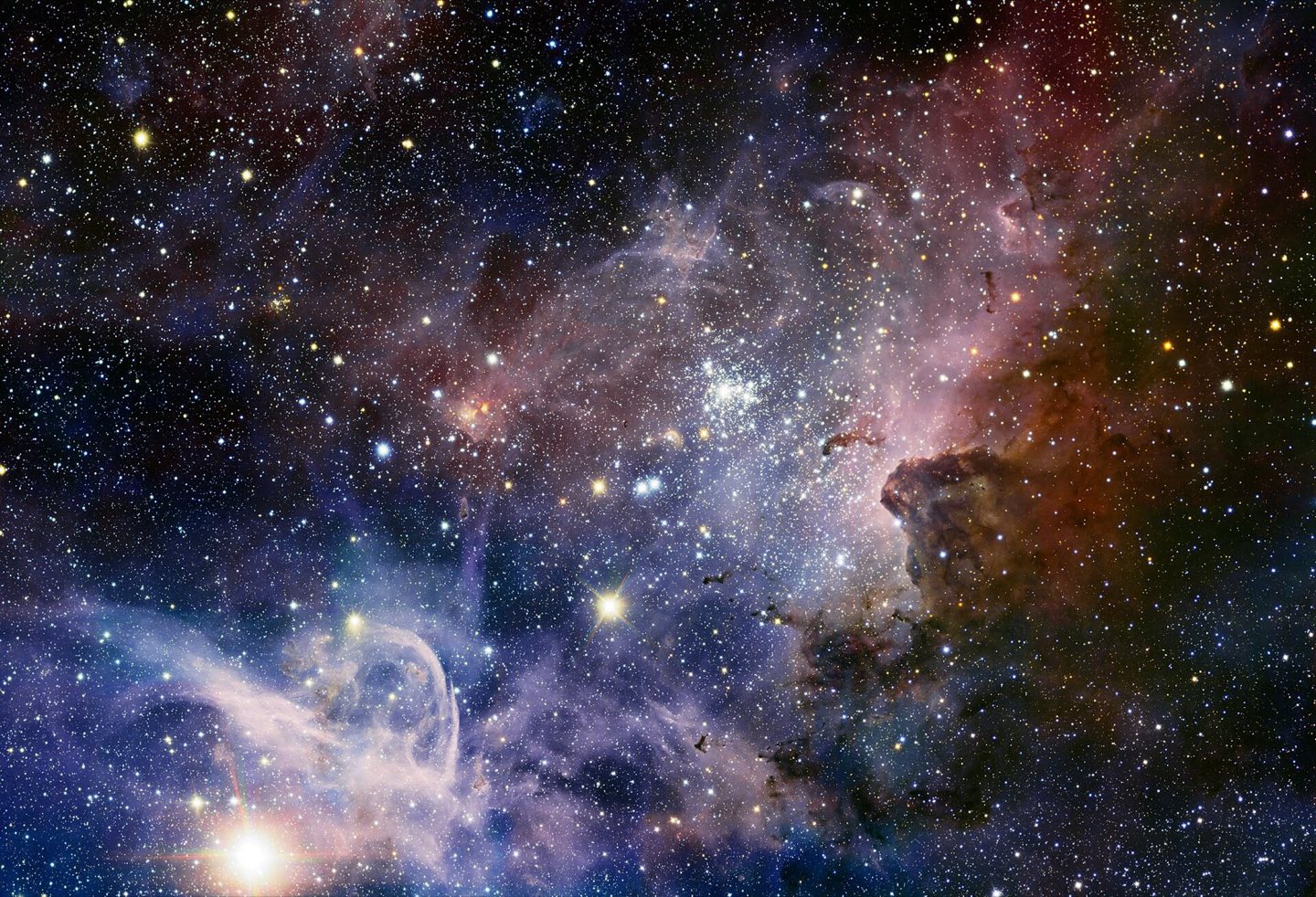
Explore the departmentPhotograph: Carina Nebula — ESO/T. Preibisch, CC BY 4.0, via Wikimedia Commons
A universe of countless worlds, running on Hukam
ਕੇਤੇ ਪਵਣ ਪਾਣੀ ਵੈਸੰਤਰ ਕੇਤੇ ਕਾਨ ਮਹੇਸ ॥
“How many winds, waters, fires. How many Krishnas and Shivas.” — Japjī Sāhib, Aṅg 7
This department reads modern cosmology, evolution and neuroscience alongside that account — without forcing either to bend — and it teaches the research method and data literacy to do the reading well.
What you'll study
Three lines of work
Creation and Hukam
Cosmology, evolution and physics read alongside Gurbani's account of a universe running on divine order.
Mind and meditation
What neuroscience and psychology say about simran, attention, and the self.
Modern literacy
Research method, data, and AI literacy — the tools of a serious student today.
Signature courses
Where to begin
Three courses that show the range of the department — an opening, a deep reading, a graduate seminar.
Faculty & sources
Taught from the authorities
Courses here are attributed to — and drawn from — the scholars whose work is definitive in the field.
Guided journeys
Follow a path, not a pile
A path runs foundations → advanced; finishing one course lights up the next.
The department curriculum
32 courses, 2 subjects
Open a subject to see its courses, foundations through graduate.
Science20 courses
Simran and Science: What Research Says About Meditation
A grounded look at what modern neuroscience says about meditation, and how it illuminates—without replacing—the 500-year-old practice of Simran taught in Gurbani.
Flat Earth Theory and Gurbani: A Critical Examination
This course provides a rigorous, graduate-quality critical examination of Flat Earth Theory, testing its claims against 2,500 years of scientific evidence while exploring what Gurbani actually teaches about the Earth and the cosmos. Students will discover that the Guru Granth Sahib's vision of countless infinite universes stands in direct opposition to the cramped, conspiratorial cosmology of the Flat Earth movement. The course also equips students with tools for critical thinking, logical analysis, and respectful dialogue — grounded firmly in Sikh values and the obligation of reason that Gurbani itself demands.
Sikhi & Science: A Harmonious View
An introduction to how the Sikh tradition relates to modern science. Gurmat invites us to observe and reflect on creation (kudrat), and Sikh thought never developed a "creation versus science" war. This course explains why, distinguishes the kinds of questions spirituality and empirical inquiry each answer, and…
Astrology, Fate, and Gurbani: What the Guru Actually Said
This course examines what the Guru Granth Sahib actually teaches about astrology, fate, and auspicious timing, contrasting Gurmat's framework of Hukam with the astral determinism prevalent in the Guru's cultural milieu. Students engage primary Gurbani passages, janamsakhis, and modern scientific literature to develop a rigorous, evidence-based understanding of why Sikhi rejects horoscopes and ritual observance of planetary positions. The course equips learners to think critically about popular astrological claims and to articulate Sikh theology on fate, free will, and divine grace.
Guru Har Rai Ji's Wildlife Sanctuary and Ecological Consciousness
This course explores Guru Har Rai Ji's maintenance of a wildlife sanctuary and botanical garden at Kiratpur as an expression of Sikh ecological theology. Students examine how the Guru's practice of caring for rare animals and plants reflects the Gurbani's vision of creation as divine, the principle of sarbat da bhala extended to all living beings, and the enduring relevance of this ecological consciousness for contemporary Sikh environmental engagement.
Life, the Body, and Gurbani: Biology through a Sikh Lens
This course explores biological science through the lens of Gurbani's reverence for creation, adopting a non-concordist approach that neither claims Gurbani predicted modern biology nor reduces Gurbani to a science text. Students examine how themes of breath, interconnection, the body's complexity, and the web of life in Gurbani invite a posture of wonder (vismad) that enriches scientific inquiry without conflating two different modes of knowing.
Sikhi and Cosmology: What Gurbani Reveals About the Universe
This graduate-level course examines what the Guru Granth Sahib reveals about the nature, origin, and structure of the universe, situating Sikh cosmological thought within the broader landscape of world religions and modern astrophysics. Students engage primary Gurbani passages in Punjabi alongside scholarly commentary to understand how concepts such as Hukam, Kudrat, Nirgun, and Sargun constitute a coherent cosmological framework. The course maintains a non-concordist approach, exploring genuine convergences and irreducible differences between Sikh theology and contemporary scientific cosmology without forcing agreement.
Technology, Artificial Intelligence, and Sikh Ethics
This course develops a Sikh ethical framework for evaluating and engaging with technology and artificial intelligence. Drawing on Gurmat principles of seva, bibek budh, equality, and the sanctity of the human being, students examine how Sikh values apply to questions of digital surveillance, algorithmic bias, AI and labor, biotechnology, and the ethical governance of powerful new technologies.
Air, Water, Earth: Ecology and the Science of Nature in Gurbani
Sikhi reads nature as the living face of the Creator. This course connects the famous closing line of Japji Sahib — air is the Guru, water the father, the earth the great mother — to modern environmental science: ecosystems, interdependence, and the Sikh basis for climate responsibility.
Countless Worlds: Cosmology in Gurbani
A plain-English, graduate-level reading of the vast cosmology pictured in Gurbani: countless realms, suns, moons, and worlds; the unknowable scale of creation; and how this vision sits beside (not inside) modern astronomy, without claiming Gurbani predicts science.
Creation, Evolution & Hukam
A plain-English, graduate-level reflection on how Sikhi thinks about where the cosmos and life came from. Gurbani does not give a dated, six-day account; it speaks of creation unfolding by ਹੁਕਮ (divine order) over time only the Creator truly knows, and of the soul travelling through many life-forms. We explore why…
Mind, Consciousness, and the Self: Sikh Thought in Dialogue with Science
A graduate-level course that puts the Sikh understanding of mind and self into conversation with modern science. It examines two key ideas in Gurbani, the restless mind (the mind) and the deeper self (the soul or consciousness), and asks how they relate to what neuroscience now says about the brain. It treats…
Science & Religion: Conflict or Harmony?
A graduate-level, plain-English course on the big-picture relationship between science and religion, read through a Sikh lens. It asks why Sikhi never had a 'Galileo moment' or a public war with science, distinguishes the kind of questions science answers (how the world works) from the kind Gurmat addresses (why…
Modern Physics, Time, and Hukam: A Capstone
A closing reflection for students who have finished the other science courses. We look honestly at what modern physics actually says about the beginning of the universe, the vastness of deep time, and the law-like order of nature, and we set that next to the Sikh idea of hukam, the divine order, and Gurbani's frank…
Quantum Mechanics, Consciousness, and Sikh Thought
This advanced course examines the genuine frontiers of quantum mechanics and consciousness science, while maintaining rigorous intellectual honesty about the speculative nature of quantum consciousness theories. Students learn what quantum mechanics actually claims, why popular 'quantum spirituality' claims often misrepresent the physics, and where genuine open questions about consciousness leave meaningful space for Sikh philosophical engagement.
Advanced Cosmology and Gurbani: Creation, Time, and Universe
This graduate seminar examines the interface between Gurbani's cosmological vision and contemporary scientific cosmology, from the Big Bang and dark energy through multiverse proposals and the search for extraterrestrial life. Students develop tools for responsible, philosophically rigorous engagement between theological and scientific accounts of the universe.
Advanced Ecology and Gurmat Environmental Thought
This graduate seminar develops a rigorous Gurmat environmental theology in dialogue with ecological science, deep ecology philosophy, climate science, and environmental justice scholarship. Students engage Kudrat, Sarbat da Bhala, and Sikh institutional traditions as resources for a comprehensive, scientifically informed ecological ethics.
Consciousness Studies and Gurmat: Neuroscience, Philosophy, and Spirit
This graduate seminar examines the interdisciplinary field of consciousness studies from a Gurmat perspective, engaging the hard problem of consciousness, meditation neuroscience, and the phenomenology of contemplative transformation. Students develop rigorous frameworks for integrating first-person Gurmat insights and third-person scientific findings.
Gurmat Metaphysics and Modern Physics: An Advanced Study
This graduate seminar explores the philosophical interface between Gurmat metaphysics and contemporary natural science — from quantum mechanics and relativity to cosmology and ecology — with methodological rigor about what kinds of dialogue are legitimate and intellectually fruitful. Students develop tools for responsible engagement at the science-religion interface.
Sikh Philosophy of Science: Epistemology and Method
This graduate seminar develops a distinctively Sikh philosophy of science, engaging major topics — paradigm shifts, theory-ladenness, scientific realism, values, demarcation, feminist critique, and technology ethics — through the lens of Gurmat epistemology. Students develop rigorous tools for bridging Sikh thought and the philosophy of science.
Modern Skills12 courses
AI Foundations
A practical, plain-English introduction to using today's AI tools well and responsibly — the assistants, image tools, model choices, and the new 'connectors' that let AI act for you.
AI Foundations: Understanding Artificial Intelligence
A plain-language introduction to artificial intelligence for everyone. This course explains what AI really is and is not, traces its journey from early rule-based systems to today's large language models, and unpacks the core ideas of data, training, models, and neural networks without any math. You will learn how…
AI Literacy: Using AI Wisely and Responsibly
AI Literacy: Using AI Wisely and Responsibly
AI, LLMs & AGI: What They Really Are
A calm, hype-free explanation of modern AI for everyone. What people actually mean by 'AI', how large language models (LLMs) really work under the hood, why they sound confident even when wrong, the difference between narrow and general intelligence, and the honest debate about whether 'AGI' is near
The Craft of Prompt Engineering: Getting the Best from AI
A practical, plain-English guide to writing prompts that get great results from AI — clear instructions, context and examples, reasoning and constraints, fixing common failures, and adapting to chat, coding, and image tools.
Working with AI: Prompting & Large Language Models
A practical, vendor-agnostic guide to getting reliable, useful work out of large language models. You will build an intuition for how these systems generate text, learn to write prompts that clearly communicate task, context, constraints, and format, and pick up core techniques such as role framing, worked…
Run AI on Your Own Computer: A Plain-English Guide to Local Models
Run AI on Your Own Computer: A Plain-English Guide to Local Models
Artificial Intelligence and Sikh Ethics: An Advanced Seminar
This graduate seminar applies Sikh ethical principles to the most pressing moral challenges posed by artificial intelligence. Drawing on the SGGS, Gurmat ethics, and leading scholarship in AI ethics, students develop rigorous frameworks for evaluating algorithmic bias, surveillance, autonomous weapons, AI consciousness, and the governance of transformative technology from a perspective grounded in Sikh values.
Critical Thinking and Epistemic Responsibility in the Sikh Tradition
This graduate seminar examines the epistemological foundations of Sikh thought, developing a rigorous account of critical thinking and epistemic responsibility grounded in Gurbani concepts such as ਵਿਚਾਰ, ਸੱਚ, and ਬਿਬੇਕ. Students engage with the SGGS as a sophisticated philosophical text that speaks to contemporary debates about knowledge, bias, and intellectual virtue.
Digital Humanities and Sikh Studies
This graduate seminar examines the application of digital humanities methods—computational text analysis, geospatial mapping, network analysis, digital archiving—to Sikh Studies, while maintaining critical awareness of the epistemological and ethical dimensions of these methods. Students develop both technical competence and the critical framework needed to evaluate and contribute to digital Sikh scholarship.
Graduate Seminar in Technology Ethics and Gurmat
This graduate seminar develops a Gurmat framework for evaluating the ethical dimensions of digital and emerging technologies. From the attention economy and social media to biotechnology and environmental technology, students apply Sikh ethical concepts — ਮਾਇਆ, ਹਉਮੈ, ਸੇਵਾ, ਕਿਰਤ ਕਰਨੀ — to assess how technological systems shape human character, community, and spiritual development.
Sikh Leadership Theory: Seva, Sovereignty, and Transformation
This graduate seminar develops a comprehensive Sikh theory of leadership grounded in the SGGS and the historical example of the Gurus, engaging major frameworks of contemporary leadership scholarship including servant leadership, transformational leadership, adaptive leadership, and authentic leadership. Students develop both scholarly analysis and personal leadership capacity rooted in Gurmat principles.
Start where your question is
You do not need a background, an application, or a fee. Pick a course and begin — the department is here whenever you want to go deeper.