School within Sikhi University
School of Language
The script, the sound, and the grammar that carries the meaning.
Gurbani's meaning lives in its language, and its language begins as sound. This school teaches you to shape the script, then to say it — the lagāṇ-mātrā and the uchaaran that decide the sense — then the grammar, then the registers: Sant Bhāṣā, Braj, Persian. Only with those in hand does the text fully open.
Explore the departmentBefore it is grammar, Gurbāṇī is sound
Every sign on the page is an instruction for the voice
The school begins here — the lagāṇ-mātrā and the uchaaran that fix the meaning — then moves to the grammar, the registers (Sant Bhāṣā, Braj, Persian), and the reference shelf that lets a reader check their own work.
What you'll study
Three lines of work
Script and sound
Writing Gurmukhi, then the phonetics — correct uchaaran, larivaar reading, and the vowel signs that carry the meaning.
Grammar and the registers
The grammar of Gurbani, and its linguistic layers — Sant Bhasha, Braj Bhasha, Persian — read on their own terms.
The reference shelf
The Mahān Kosh, the concordances, the encyclopaedias and the palaeography that let a reader check their own work.
Signature courses
Where to begin
Three courses that show the range of the department — an opening, a deep reading, a graduate seminar.
Faculty & sources
Taught from the authorities
Courses here are attributed to — and drawn from — the scholars whose work is definitive in the field.
Guided journeys
Follow a path, not a pile
A path runs foundations → advanced; finishing one course lights up the next.
The department curriculum
26 courses, 2 subjects
Open a subject to see its courses, foundations through graduate.
Language14 courses
Gurmukhi & the Grammar of Gurbani
This course teaches how the Gurmukhi script and the grammar of Gurbani work together to unlock the correct meaning of the sacred word. Students learn the thirty-five letters, the vowel signs (ਲਗਾਂ ਮਾਤ੍ਰਾਂ), and the additional marks, and then study how a final vowel sign on a noun or verb changes meaning. The…
Reading Gurmukhi: The Script
A gentle beginner's introduction to the Gurmukhi script, the writing system in which the Guru Granth Sahib Ji and much Punjabi literature are recorded. This course traces the script's history and its association with Guru Angad Dev Ji, walks through the Painti (the thirty-five base letters) grouped by how they are…
Conversational Punjabi I
A beginner-friendly introduction to spoken Punjabi for everyday life. You will learn warm greetings and courtesies, build simple sentences with pronouns and present-tense verbs, count and tell time, talk about family and common objects, ask questions, and handle practical situations like ordering food, finding…
Reading Gurbani by Its Endings: Giani Harbans Singh's Simple Grammar
This course introduces the approach to Gurbani grammar set out in Giani Harbans Singh's ਗੁਰਬਾਣੀ ਸਰਲ ਵਿਆਕਰਣ (Gurbani Saral Viyakaran, 'Simple Gurbani Grammar'). The central idea is that the small vowel-signs and word-endings of Gurbani are not decoration: they carry meaning. A word can change its sense depending on…
Advanced Gurmukhi: Reading Gurbani with Confidence
Bridge the gap from knowing the alphabet to reading Gurbani fluently. Master every vowel sign, the tricky sihaaree, addhak, nasal markers, Gurbani spellings, and build speed with Japji Sahib.
Gurmukhi Script: Guru Angad Dev Ji's Gift to the Panth
This course examines the Gurmukhi script — its origins, structure, standardization under Guru Angad Dev Ji, and its profound role in Sikh identity and literacy. Students will learn the historical context of script development in Punjab, the theological significance of writing as a form of service to Gurbani, and how Gurmukhi became the medium through which the Sikh scriptural tradition was preserved and transmitted.
Learning Punjabi Through Gurbani
An intermediate course that builds Punjabi vocabulary and reading comprehension through the language of Gurbani. You will learn high-frequency devotional words and their meanings, see how the older Sant Bhasha register differs from everyday modern Punjabi, grasp core grammar concepts at a conceptual level, and…
Reading Larivaar and Pad-Ched: How Gurbani Is Written and Read
A graduate-level study of how Gurbani is set down on the page and how it is correctly read aloud. The course contrasts ਲੜੀਵਾਰ (larivaar), the unbroken running script with no spaces between words, against ਪਦ ਛੇਦ (pad-ched), the modern word-separated text. It examines the interpretive choices and risk
The Many Tongues of Gurbani: Sant Bhasha
Sri Guru Granth Sahib Ji does not speak in one single language. It moves freely between Punjabi, the devotional Braj of the Bhakti poets, Persian and Arabic terms, the heavy Sanskritic register often called Sahaskriti, and many regional dialects. This blended saintly speech is known as Sant Bhasha,
Advanced Gurbani Grammar and Syntax
This graduate seminar provides a comprehensive and rigorous study of <span class='gur'>ਗੁਰਬਾਣੀ</span> grammar and syntax, using Prof. Sahib Singh's <em>Gurbani Vyakaran</em> as the foundational text while extending the analysis through advanced morphological and syntactic study. Students develop the grammatical competence required for independent advanced analysis of <span class='gur'>ਗੁਰਬਾਣੀ</span> passages, mastering the archaic features, multi-language constructions, and poetic syntactic inversions that characterize the language of the <span class='gur'>ਗੁਰੂ ਗ੍ਰੰਥ ਸਾਹਿਬ</span>.
Advanced Gurmukhi: Grammar, Prosody, and Poetic Structure
This graduate seminar undertakes an advanced analysis of Gurmukhi as both a script and a literary language, examining the grammatical structures, prosodic systems, and poetic conventions of Gurbani with scholarly rigor. Drawing on Prof. Sahib Singh's <em>Gurbani Vyakaran</em> and the prosodic diversity of the SGGS, students engage the full range of classical Indian metrical forms deployed by the Gurus alongside the unique linguistic features of the Gurbani idiom. The course is essential for scholars seeking to read and interpret Gurbani in the original.
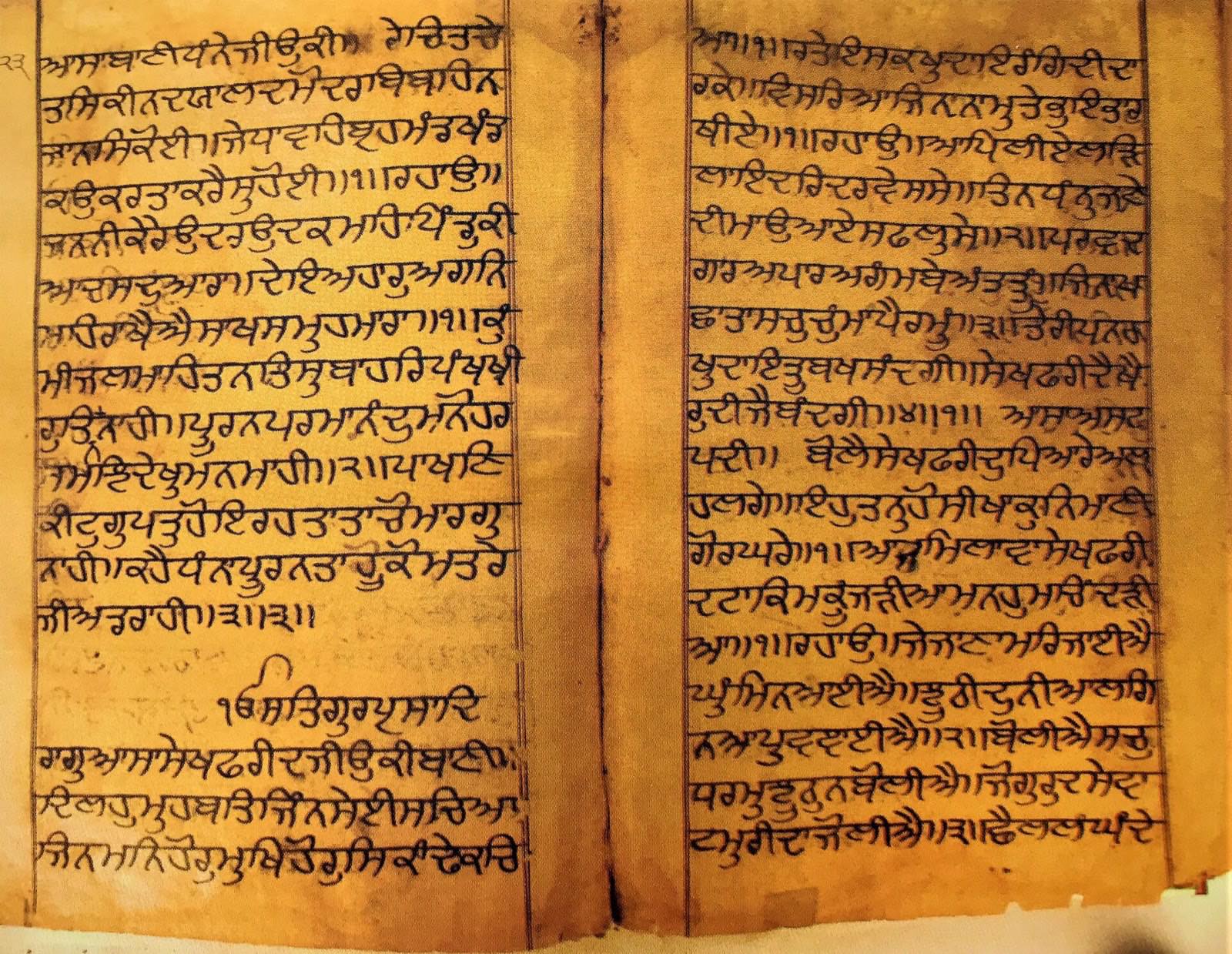
Gurmukhi Paleography: Reading Historical Manuscripts
This graduate seminar develops the skills required to read, date, and critically analyze historical Gurmukhi manuscripts from the sixteenth through the nineteenth centuries. Students learn the methods of Gurmukhi paleography, codicology, and manuscript studies, applying these to Sikh primary sources including early Guru Granth Sahib manuscripts, Rehatnamas, and court documents. The course bridges linguistic competence and archival research, equipping scholars for original manuscript-based research.
Historical Linguistics of Punjabi and Gurmukhi
This graduate seminar traces the historical development of the Punjabi language and the <span class='gur'>ਗੁਰਮੁਖੀ</span> script from their Indo-Aryan origins through the medieval period and the Gurbani corpus. Students apply the methods of historical linguistics — phonological reconstruction, morphological change, lexical borrowing — to Punjabi and to the linguistic register of <span class='gur'>ਗੁਰਬਾਣੀ</span>. The course situates Punjabi within the broader context of Indo-Aryan language history and examines the <span class='gur'>ਗੁਰਮੁਖੀ</span> script's origins, development, and standardization.
Sant Bhasha: Advanced Study of Gurbani's Linguistic Register
This graduate seminar provides an advanced study of <span class='gur'>ਸੰਤ ਭਾਸ਼ਾ</span> — the pan-regional devotional register of North Indian bhakti literature — as it appears in the <span class='gur'>ਗੁਰੂ ਗ੍ਰੰਥ ਸਾਹਿਬ</span>. Students analyze the linguistic features of this register across the Gurbani corpus, examining its relationship to Sanskrit, Persian, and regional vernacular traditions. The course develops both linguistic and hermeneutic competencies essential for advanced Gurbani scholarship.
Reference & Lexicography12 courses
A Glossary of Key Sikh Terms
A learner's glossary of the most important Sikh terms, grouped by theme and defined in plain English at graduate depth. The course works as a reference: each lesson is built around a table that pairs the Gurmukhi term with a clear, mainstream definition. It covers the Divine (Ik Onkar, Waheguru, Huk
The Sikh Reference Shelf: Encyclopedias, Dictionaries & Gazetteers
A plain-English, graduate-level guide to the great reference works of Sikh studies — Bhai Kahn Singh Nabha's Mahan Kosh, Harbans Singh's four-volume Encyclopaedia of Sikhism, the dictionaries of Gurbani, the colonial gazetteers, and the field's bibliographies. You will learn what each tool does best
A Reader's Guide to the Mahan Kosh
A practical, plain-English guide to using Bhai Kahn Singh Nabha's ਮਹਾਨ ਕੋਸ਼ (Gurushabad Ratnakar Mahan Kosh). Students learn what this encyclopedic dictionary of Sikh literature is, how it is organised, how to look up a term step by step, why scholars treat it as a landmark reference, and how to use
Bhai Desa Singh and His Rehatnama: A Sikh Code of Conduct in Context
This course studies Bhai Desa Singh and the short text attributed to him, the Rehatnama, one of several historical Sikh codes of conduct that try to describe how a member of the Khalsa should live. Working in simple English at a graduate level, the course explains what a rehatnama is, what kind of conduct these…
Bhai Kahn Singh Nabha: The Great Encyclopedist
An advanced survey of the life, scholarship, and lasting influence of Bhai Kahn Singh Nabha (1861-1938), the towering lexicographer of the Singh Sabha era. This course examines his masterwork, the Gurushabad Ratnakar Mahan Kosh, his widely read tract Ham Hindu Nahin, his lexicographical method, his collaboration…
Finding the Verse: Gurbani Concordances, Tuk Indexes, and the Craft of Reference Tools
A graduate study of the tools that index and explain Gurbani: tuk and shabad concordances (the Gurbani-locating tradition exemplified by tatkara and tuk-index works), word-meaning kosh, and grammar aids. The course shows in plain English how a reader moves from a half-remembered line to the exact pa
Unlocking Gurbani Vocabulary: Giani Kirpal Singh and the Craft of a Gurbani Word-Meaning Kosh
This course studies the work of Giani Kirpal Singh as a reference author, focusing on his Gurbani word-meaning kosh, the Sam Arth Kosh. A kosh (ਕੋਸ਼) is a dictionary or lexicon. A Gurbani kosh collects difficult words from the scripture and explains their meanings (ਅਰਥ), often by listing synonyms and showing how a…
Advanced Lexicography: Mahan Kosh and Sikh Dictionary Traditions
This course offers graduate-level analysis of Kahn Singh Nabha's Mahan Kosh (1930), the monumental Punjabi-Sikh encyclopedia-dictionary, situating it within South Asian and global lexicographic traditions. Students examine the methodological, theological, and political dimensions of Sikh dictionary-making from early manuscript glossaries through the Singh Sabha reform era. The course develops competency in critically evaluating lexicographic choices as acts of cultural and political construction.
Archival Studies and the Preservation of Sikh Heritage
This course provides graduate-level training in archival science as applied to Sikh heritage materials, combining theoretical frameworks from the archival studies discipline with practical knowledge of the specific challenges of Sikh institutional, community, and sacred archives. Students examine the SGPC archives, Punjabi University collections, British Library India Office Records, and diaspora community archives through the lens of archival theory, developing the skills to evaluate, describe, and advocate for the preservation of Sikh heritage materials.
Bibliographic Methods in Sikh Studies
This course trains graduate students in the specialized bibliographic methods required for advanced research in Sikh Studies, from navigating primary manuscript and printed sources through constructing scholarly apparatus in academic writing. Students develop expertise in identifying, evaluating, and citing Sikh primary and secondary sources across multiple languages, scripts, and historical periods. The course emphasizes both the technical skills of bibliographic research and the critical thinking required to evaluate source quality and scholarly significance.
Digital Sikh Archives: Preservation, Access, and Scholarship
This course provides graduate-level training in digital humanities methods as applied to Sikh archival materials, examining the theoretical, technical, and ethical dimensions of digitizing, preserving, and providing access to Sikh manuscripts, audio recordings, visual materials, and institutional records. Students analyze existing Sikh digital archives critically and develop skills for participating in archival digitization and digital scholarship projects. The course situates Sikh digital archival work within global digital humanities debates about access, authority, and community ownership.
Encyclopedic Traditions in Sikh Literature
This course examines the encyclopedic impulse in Sikh literature — the drive to collect, organize, and present comprehensive knowledge about the tradition — from early commentarial and biographical compendia through the monumental Mahan Kosh to contemporary digital reference projects. Students analyze encyclopedic texts as epistemological and political projects, examining how the organization and selection of knowledge reflects and constructs understanding of what Sikhism is. The course situates Sikh encyclopedic traditions within global comparative perspectives on encyclopedism as a cultural form.
Start where your question is
You do not need a background, an application, or a fee. Pick a course and begin — the department is here whenever you want to go deeper.